|
Abstract:
Introduction:
Journal club’s curriculum has essential role in medical education training programs. Objective of this study was to compare the influence of different moderating style of journal club on standpoints of two separate groups of psychiatric residents.
Method:
Forty two psychiatric residents from two public psychiatric training centers have been questioned in this regard. Sessions of journal club in the first group
(n=24) were usually presented under the guidance of chief residents, while the second group (n=18) was being directed mainly by an experienced member of the associated faculty. After at least one year of attendance in correlated sessions of journal club, all of the abovementioned residents were asked to reply anonymously to a Survey Questionnaire, including 23 questions, in the company of a series of answers in the frame of different Coding Categories.
Results:
All of the residents completed the questionnaires. Significant difference was palpable among these two clusters of participants concerning their respond to at least 12 questions. Opinion of residents were generally and remarkably unalike with respect to the : ‘goals’ , ‘format’ ,’necessity of attendance’ ,’quality of participation of faculty’ , ‘educational value of core curriculum of journal club’, ‘its critical role with regard to research and appraisal of topics ‘, and finally ‘as a resource for continuous education’.
Conclusion:
Methodical supervision of journal club by expert and enthusiastic faculty member may generate more practical insight with respect to such important educational program.
Key Word:
residency; journal club; educational program.
Introduction:
Journal club is an acknowledged part of most of the educational medical programs. Also, it has been described as one of the important foundations for elaboration of evidence-based medicine and necessary skill for critical evaluation of medical literature (1, 2, and 3). Over the last 10 years, a number of publications have discussed the goals, organization, and teaching methods of journal club and measured the correlated outcomes (4, 5, 6, and 7 ). Initially, journal clubs merely served to help practitioners to pursue scientific progresses (8, 9), but more recently they have been used as a vehicle for teaching critical appraisal skills, research designs, medical statistics, and clinical epidemiology (10). Although ‘teaching critical appraisal skills’ is among the abovementioned major goals, but Journal club formats are educationally diverse and in the meantime are flexible for teaching the "new basic sciences" (11). In addition, though most training programs support journal clubs, but they are not equally successful in meeting their educational goals, or maintaining resident attention. Common reasons for discontinuing journal clubs appear to be lack of time, inadequate preparation, and lack of goals, interest, or enough participants (8, 11). In this regard, Sidorov had defined successful journal clubs as those with adequate longevity (at least 2 years) and high levels of resident participation (at least 50% attendance) (12). Valuable parameters for a successful journal club, based on the existing literature, could include the following: 1) the use of a structured review checklist, 2) explicit written learning objectives, and 3) a formalized meeting structure and process. The journal club can prove to be an excellent tool for the assessment of competencies like practice-base learning, which is a bit difficult to be assessed by other methods (13). Success of journal club can be defined by many different parameters, but factors associated with high attendance and longevity includes mandatory attendance, availability of food, and perceived educational value by the program director. Other factors associated with effective journal club may be listed as: formal teaching of critical appraisal skills, regular attendance by facultymembers, smaller participation (12 or less residents), incorporation of adult learning principles, use of a structured checklist for article review and having a designated club leader (14). The effect of supervision on journal club’s outcome is not precisely obvious, but educational satisfaction may perhaps be higher in clubs moderated by the faculty. Associated studies by Van Derwood (15) and Linzer (16) hitherto have resulted in incongruous findings with respect to the vital influence of quality of guidance on eventual outcome of such educational curriculum. For instance, while Van Derwood had put importance on faculty or a faculty-and-resident team with respect to enhancement of efficacy, Linzer demonstrated higher attendance rates in journal clubs directed by chief residents. So, the objective of the present study was to compare the influence of different moderating styles of journal club, faculty member vs. chief resident, on educational perspective of two groups of residents that were training in two public psychiatric training centers.
Method:
Forty two psychiatric residents from two different psychiatric training centers in the capital city have been questioned in this regard. The first sample included 24 psychiatric residents from one of the main state universities (IUMS) and the second sample included 18 psychiatric residents from a relatively new public university (USWR). In both of them bi-Weekly journal club (one article in approximately one hour during the workday), as one of the scholastic programs in accompany with other academic curriculums, was being performed.
Standard similar psychiatric journals were among the main theoretical supplies for both of them. In the first group (IUMS), articles were selected individually by a faculty member, who was as well its coordinator, while in the second group (USWR) they were selected usually during joint sessions, involving a faculty member, as director and coordinator, and the related chief resident. Generally In both of the abovementioned centers clinical research papers and systematic reviews were the most favorite choices. Participation of all of the residents in the journal club sessions were mandatory in both of the above centers, which was again more compulsory in USWR, and faculty members also were encouraged in both of them to attend the sessions enthusiastically. The general settings were comparable between the aforementioned groups.
The sessions of journal club in IUMS were usually performed under the guidance of the chief resident, sometimes in accompany with feeble contribution of some of the faculty members; while in the USWR it was being directed mainly by an experienced member of the associated faculty, in accompany with constant involvement of a few of other faculty members.
At the end of every session, shared talk and critical review of the discussed issue was expectable in both of them. It is mentionable here that neither of the abovementioned faculties or residents in none of the aforementioned centers had experienced any preparatory course for acquaintanceship with the goals, values or importance (scientific or clinical) of journal club curriculums.
After at least one year of attendance in correlated sessions, and during a distinct week period, all of the aforesaid residents were asked to reply anonymously to a Survey Questionnaire; including 23 questions in the company of a series of answers in the frame of different Coding Categories. This Questionnaire had been used as Community Medicine (Public Health) Resident Journal Club (CMR-JC) survey in some previous similar studies (17).
Statistical analysis:
Residents were compared on baseline characteristics using chi-square tests for categorical variables and t tests for continues variables, in order to assess the homogeneity between the two assessed groups. Analysis of data was done by means of comparison of proportions. Proportions in each group were calculated according to the percent of responds to different Coding Categories. The later as well was elected according to the most repeated comparable preferred response among the two aforesaid clusters for between-group comparisons. Significance was defined as P=or<0.05.
Results:
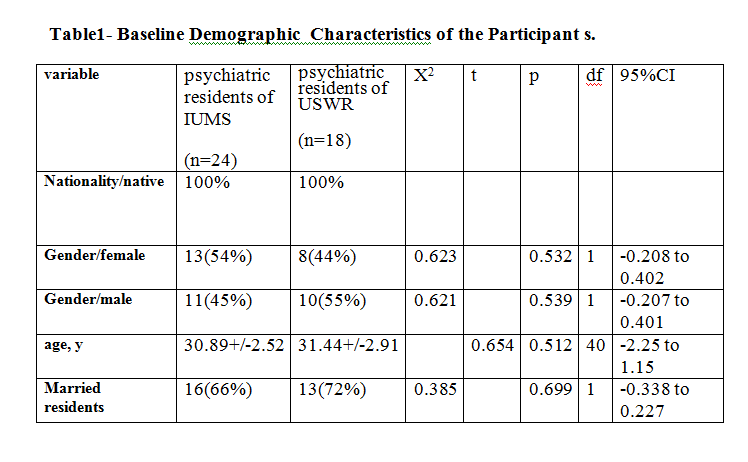
Groups were initially comparable and demographic variables were analogous (Table1).
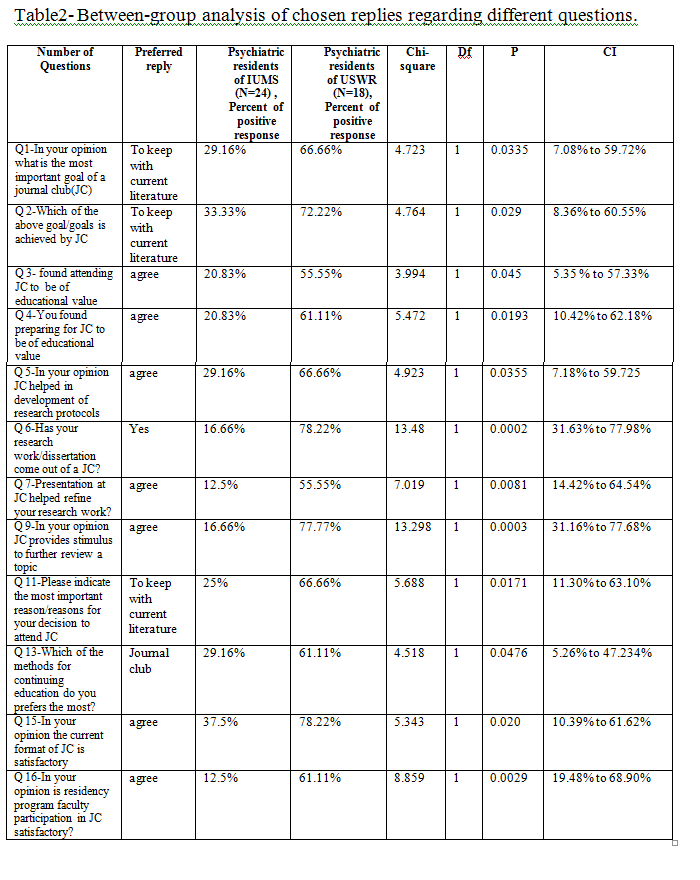
All of the above-mentioned residents in both groups responded incognito to the aforesaid Survey Questionnaire. Among 23 different queries in CMR-JC, the preferred analogous response to one specific reply, among a variety of answers, in 12 of them was significantly different in between-group analysis (Table 2).
“To keep with current literature” was the most common reply among both groups concerning the first question [what is the most important goal of a journal club (JC)], which was significantly more prevailing in USWR (66.66% vs. 29.16%, X2=4.72, P=0.03). Also regarding the same question, the second most reply in both groups was “to impact clinical practice”, which showed nearly equal percent in this regard (15-20%). Neither of the residents in nor of the groups had pointed to other expectable replies as like as “to teach critical reading skills” or “to improve reading habits”.
With respect to the second question [Which of the above goal/goals is achieved by JC], 77.22% of the residents of USWR vs. 33.33% of them in IUMS pointed to “keep with current literature”(X2=4.76, P=0.02), while a few of the respondents (<12%) marked the third coding category (“to teach critical reading skills”) and again neither of them pointed to the 4th answer (“to improve reading habits”). Some of the respondents also marked 5th answer (“any other”) with a mixture of individual standpoints.
With respect to the 3rd [found attending JC to be of educational value], 4th [You found preparing for JC to be of educational value], 5th [In your opinion JC helped in development of research protocols], 7th [Presentation at JC helped refine your research work?], 9th [In your opinion JC provides stimulus to further review a topic], 15th [In your opinion the current format of JC is satisfactory] and 16th [In your opinion is residency program faculty participation in JC satisfactory?] question, the primary response of repliers was “agree”, which again was significantly different among the groups(P= 0.04,0.01,0.03,0.003,0.0008,0.02 and 0.002 on behalf of the USWR, correspondingly).
The second most repeated reply with regard to the abovementioned questions was “neither agree nor disagree”. Neither of residents in nor of the groups answered “strongly disagree” or “strongly agree” as regards any of the aforementioned questions in this survey.
Once again, regarding the 6th question [Has your research work/dissertation come out of a JC?], 78.22% of the residents in USWR vs. 16.66% of them in IUMS responded positively (“Yes”) (X2=13.48, P=0.0002).
As regards the 11th question [indicate the most important reason/reasons for your decision to attend JC] also 66.66% of the respondents in USWR versus 25% of them in IUMS pointed “To keep with current literature” (X2=5.688, P=0.017).In this regard the second most repeated answer, in both groups, was “to impact clinical practice” (20.83% and 16.66% in USWR and IUMS, respectively). A few also had pointed to other answers like “mandatory attendance” and “to improve presentation skills” or “others”. But again neither of them had pointed to answers like “to learn epidemiology /biostatistics” or “to learn critical reading skills”.
Also respecting the 13th question [Which of the methods for continuing education do you prefers the most?], 61.11% of the respondents from USWR vs. 29.16% of them from IUMS pointed to “Journal club”(X2=4.518, P=0.047). In this regard the second most preferred reply was “conferences” in both groups (25% and 38.88% in USWR and IUMS, respectively).
There was no important difference between those two groups of residents with respect to the remaining 11 items, which included:
‘In your opinion JC provides good review of public health related literature?’ (Question8); ‘In your opinion JC facilitate development of critical appraisal skills’(Question 10)’; ‘Which key journals would you like to be made mandatory for the residents to review?’(Question 12);’ Do you think that introduction of a standard check list for review of different segments of an article would be helpful to improve resident participation?’(Question 14);’ In your opinion is departmental faculty participation in JC satisfactory?’(Question 17);’ Have you ever presented a mock presentation before JC?’(Question 18);’ In your opinion is presenting a mock presentation a valuable exercise in preparing for JC?’(Question 19);’ Have you ever been assigned the responsibility of JC coordination?’(Question 20);’ In your opinion is/was coordinating JC was a helpful experience to your own residency training?’(Question 21);’ Is the timing of journal club (i.e. the first thing in the morning) appropriate?’(Question 22);’Recommendations to improve over all quality of JC’ (Question 23).
Discussion:
Although numerous articles discuss how journal clubs can be used to evaluate medical literature, only a few have examined what physicians are actually doing (15). It is clear from literature review that essentially an ideal journal club format may not exist. Rather, the format depends on the goals of the journal club, the parameters used to define success, and the available resources. For example it has been stated that residents exposed to critical appraisal techniques in a journal club report paying more attention to the methods and becoming more skeptical of the author's conclusions. In a survey of family practice journal clubs, Van Derwood et al. assessed journal clubs by resident attendance and perceived educational value by the program director (15). Attendance rates were highest in clubs moderated by the faculty or a faculty-and-resident team as compared with clubs moderated by residents alone. Also there was a significant correlation between the attendance at journal clubs by the faculty and residents and the program director's perception of its educational value. In all cases, attendance was highest when program directors rated its educational value as “vital” and lowest when it was rated as having “no educational impact.”
Heiligman and Wollitzer defined success in family practice journal clubs by the level of satisfaction of program directors with the educational experience (18). Variables associated with high levels of satisfaction were the regular attendance by program faculty, having a designated leader, and mandatory attendance.
In contrast, Linzer demonstrated higher attendance rates in a journal club led by a chief resident, with invited subspecialist faculty, as compared with one moderated by a general internist (16). However, residents assigned to the faculty-led club were considerably more pleased with their educational experience.
Also Linzer and colleagues compared two formats for teaching critical reading skills to internal medicine residents; one journal club was led by a generalist faculty member, and the other by a chief resident with invited subspecialists (18). According to the findings, the faculty-led team reported reading fewer articles,
although there was a trend of reading them more completely. More members from the faculty-led team reported that the journal club experience changed their reading habits, primarily by making them more skeptical of the author's conclusions. Neither team reported that the journal club experience altered the ways in which they utilized the literature in their practice of medicine.
Objective of the present assessment was to appraise the quality of supervision on the educational outcome of journal club. According to the findings, quality of guidance and chairing may have direct influence on final outcome of such kind of curriculum. Such finding is in complete harmony with the findings of Van Derwood. Although the chief resident in the related center, in accompany with the other senior residents, had the major managing role in the sessions, but the final outcome was not comparable with the other center’s curriculum directed by a faculty member. Perhaps scientific knowledge needs to be integrated too with reasonable insight, expertise, enthusiasm or a combination of them.
The other result could be that the various goals of core curriculum of journal club may not be achieved without preliminary enlightening and clarification. In spite of numerous critical discussions, particularly in the younger training center, the other common goals of such program, in addition to “keeping up with the current medical literature”, such as “teaching critical appraisal skills”, “having impact on clinical practice” and “improvement of reading habits”, were concealed by explicit clinical viewpoints of the participants in the present assessment. Comparable responses of residents in this evaluation, demonstrated lack of essential multidimensional scholastic insight, which demands for further systematic endeavors to supply miscellaneous pedagogic purposes of such set of courses. Therefore even though it is likely that managing of core curriculum of journal club by faculty members may enhance resident’s involvement ,knowledge and insight , but for sure, the club director as well needs to be experienced and sophisticated to be able to achieve the complete stated goals.
Small sample sizes and restriction of study to a few academic training centers were among the weaknesses of this survey. Findings of this investigation call for further proof, through more comprehensive and attentive studies.
Conclusion:
Methodical supervision of journal club by expert and enthusiastic faculty member may bring into being more practical insight with respect to such important didactic program.
References:
1. Kuhn JG, Wyer PC, Cordell WH, et al: A survey to determine the prevalence and characteristics of training in evidence based medicine in emergency medicine residency programs. Education. 2005; 28:353–9.
2. Cramer JS, Mahoney MC. Introducing evidence based medicine to the journal club, using a structured pre and post test: a cohort study [e-publication]. BMC Med Educ. 2001; 1:6.
3. Dirschl DR, Tornetta PT, Bhandari M. Designing, conducting, and evaluating journal clubs in orthopaedic surgery. Clin Orthop Relat Res. 2003; 413:146–57.
4- A Handbook for Medical Teachers (3rd Edition) Newble D & Cannon, R. Lancaster, Kluwer Academic Publishers,1994.
5- Effective Feedback Skills (The Practical Trainer Series) Russell T. London, Kogan Page Ltd; 1998.
6- How to Read a Paper Greenhalgh T & Weatherall, D. London, BMJ Books; 1997.
7- Handbook of Clinical Teaching. Watts, NT. Edinburgh, Churchill Livingstone. 1990.
8- Linzer M. The journal club and medical education: over one hundred years of unrecorded history. Postgrad Med J. 1987; 63:475.
9- Heiligman RM, Wollitzer AO. A survey of journal clubs in U.S. family practice residencies. J Med Educ. 1987; 62:928.
10- Inui TS. Critical reading seminars for medical residents. A report of a teaching technique. Med Care. 1981; 19:122.
11- Alguire PC: A review of journal clubs in postgraduate medical education. J Gen Intern Med. 1998 May; 13(5):347-53.
12. Sidorov I. How are internal medicine residency journal clubs organized, and what makes them successful? Arch Intern Med. 1995; 155:1193.
13- Lee AG, Boldt HC, Golnik KC, Arnold AC, Oetting TA, Beaver HA, Olson RJ, Carter K. Using the Journal Club to teach and assess competence in practice-based learning and improvement: a literature review and recommendation for implementation. Surv Ophthalmol. 2005 Nov-Dec; 50(6):542-8.
14- Saima Akhund1 and Muhammad Masood Kadir: Do community medicine residency trainees learn through journal club? An experience from a developing country,BMC Medical Education 2006, 6:43.
15. Van Derwood JG, Tietze PE, Nagy MC. Journal clubs in family practice programs in the southeast. South Med J. 1991; 84:483.
16. Linzer M, DeLong ER, Hupart KH. A comparison of two formats for teaching critical reading skills in a medical journal club. J Med Educ. 1987; 62:690.
17- Moberg-Wolff EA, Kosasih JB: Journal clubs. Prevalence, format, and efficacy in PM &R. Am J Phys Med Rehabil. 1995 May-Jun; 7(3):224-9.
18. Heiligman RM, Wollitzer AO. A survey of journal clubs in U.S. family practice residencies. J Med Educ. 1987; 62:928.
|