|
Abstract:
Introduction: Sociobiology and its implication in psychology and psychiatry had resulted in a new concept regarding the etiological perspective of human behavior from an evolutionary point of view. This experiment tries to set up some hypothetical affiliation between obsessive-compulsive personality trait, vis-à-vis other characters, and general achievement of human being, as a general process.
Method:
Four hundreds, randomly chosen, parents had been asked regarding the existence of obsessive-compulsive personality traits, in their highest and lowest successful children to see that whether there is any significant difference among them with respect to those traits.
Results:
there was a significant difference between the highest and lowest successful offsprings in this regard and such a spectrum of traits was meaningfully more prevalent in the earlier group.
Conclusion:
Obsessive-compulsive personality traits seem to have been one of the main behavioral aspects that contribute the persons toward attainment of success.
Key words: obsessive-compulsive personality trait, sociobiology, evolutionary psychology and psychiatry.
Introduction:
Personality traits, as is supposed in evolutionary psychology, are a mixture of required policies, which relate to eventual fulfilling of organism's needs (at this juncture, human being).
If so, then and according to the Darwinistic or selectionist thinking paradigm, every part of such complex structure would have been created according to a special situation, drive or need, which has made adaptation with the environment more feasible. (1, 2)
Among different traits, throughout history, it might be presumed that traits belonging to cluster A personality disorders (paranoid, schizoid and schizotypal) were generally stranger-avoidant and also were historically-phylogenetically in the service of colonies security and harmony and do as defensive mechanism against rival groups. Traits belonging to Cluster B (narcissistic, borderline, histrionic and antisocial) may be perceived as self-centered characteristics in the service of organism's vital needs. And finally, traits belonging to Cluster C (avoidant, dependant and obsessive-compulsive) with their anxious expressions maybe can guarantee human safety against external dangers by reducing his competition and /or adherence to group's values and obeying tribe's rules. Each one of these traits could also have other specific characteristics, which together satisfies different aspects of human drives.
Among all of these, obsessive-compulsive personality traits seem to have been appropriate for guaranteeing human success. Believing in orderliness and preoccupation with details, perfectionism, devoting to work, conscientiousness, parsimoniousness, insisting on well-organized decisions and putting force on others for obeying them, all of these are in contrast with the chaotic life style of borderline, exploitative style of narcissistic, social disregard of antisocial, guardedness of paranoid , social avoidance of schizoid and schizotypal, isolation of avoidant , passivity of dependant, and attention seeking efforts of histrionic.
For appraisal of such hypothesis therefore we accomplished a survey to assess that is there basically any conspicuous relationship between obsessive-compulsive traits and success of people.
Method and Material:
Four hundreds families, who have been chosen randomly among usual clientele to a general medical clinic, has been asked regarding the existence of obsessive-compulsive traits, assumed from the diagnostic criteria table in the Diagnostic and Statistical Manual of Mental Disorders,5th edition, in their highest and lowest successful children. Success was defined broadly as the “greatest obtainable achievement” in social, personal, educational and occupational aspects of life, according to ‘their own standards and perspectives’. Mothers, fathers or both of them were asked by a self-reply questionnaire, which included the complete obsessive-compulsive traits, specified with separate checkmark columns for highest and lowest successful children. Besides it had been stressed for responders that such definition of “success” could only be justifiable, when there was no external and inevitable factor responsible for its achievement or frustration. The families with less than two children or children less than 14 years old were excluded from the study. If there were more than two children above 14 years old, the parents were asked to choose among all of them the highest successful and the lowest successful ones by their own decision, with respect to their personal socio-cultural values.
Statistical analysis:
Data were analyzed by z test for comparison of proportions. Significance also was defined as a p value equal to or less than 0.05.
Results:
The demographic characteristics of the children have been shown in table 1. Eight hundreds children, who were inquired in this regard, included 393 male and 403 female cases (z = -0.7000, p-value =0.4839, 95%CI = -0.0665, 0.0315).
In this regard, test for the difference between two Independent proportions did not show any gender-based significance among highest (z = 0.5657, p-value =0.5716, CI 95%=-0.0493, 0.0893), and lowest successful cases (z = -1.5556, p-value =0.1198, CI 95& = -0.1243, 0.0143).
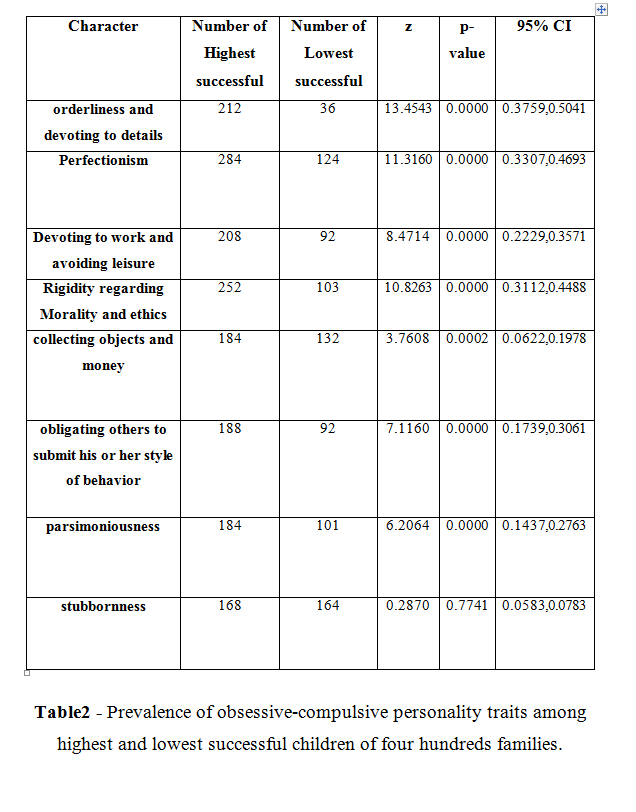
According to the results, except for stubbornness, all of the remaining traits were significantly more prevalent among the highest successful children in comparison with the lowest ones (Table 2).
“Perfectionism” was the most prevalent trait among successful cluster of children, tagged along by “Rigidity regarding Morality and ethics”, “orderliness and devoting to details” and “Devoting to work and avoiding leisure”. Incidentally, “obligating others to submit his or her style of behavior”,” collecting objects and money” and finally “parsimoniousness”, as well were the least prevalent traits.
Discussion:
According to the findings, obsessive-compulsive traits are prominent characteristic of successful people. So it might be supposed intrepidly that:
1) Obsessive-compulsive traits, in general may perhaps promote attainment of valuable individual-social goals and 2) if this inference could be factual, then such spectrum of traits might be theoretically essential for foundation and progression of civilization through history of human being, and last of all, 3) such kind of difference may be found as well at the bottom of developmental differences among various societies. Although, every society is undoubtedly a mixture of people with a blend of traits, but such combination is not inevitably homogeneous among them. Alternatively, although we don’t know that how much genetic heritage or environmental acquisition , separately, contribute to the behavioral substrate of human being, but we are inform that both of them are major determinants in this process. Surely, the genetic component of behavior and its acquired one (by training or modeling) are capable of reinforcing each other in the context of society. In addition, some of the researches see some relationship between above average IQ and obsessive-compulsive disorder (Rafman, Hogson, 1980), which is superimposed on Obsessive-compulsive traits in 15-30% of cases, and moreover, psycho-dynamically, there is many similarities concerning the defense mechanisms involved in these two interrelated morbid phenomenon .Thus maybe there is some mutual relationship as well between fine IQ and obsessive-compulsive traits. Devoting to rules and details, insisting on orderliness and correct accomplishment of affairs, inflexibility or insisting on moral values and ethics, saving money or objects instead of illogically wasting them, inclination toward perfecting duties instead of breakability and indifference, and asking others to obey the above characteristics, all are qualities which exist habitually and openly in every civilized and non civilized culture. If such a supposition is right, therefore may we perhaps find that there is different prevalence of them in different societies and thus a higher pervasiveness in highest developed societies in comparison with the lowest ones? If so, therefore is not it a civilization marker from a behavioral perspective?!
No doubt, such a daring reasoning awaits further researches in the future.
Weak points of this study, which didn’t permit us to consider that more than a small pilot study, were 1) all or nothingness of the traits in questioned persons, which exclude the intermediate ones from the study; 2) subjective definition of successfulness according to parental own judgments 3) small sample size and finally 4) possible existence of different intervening variables (environmental) that could influence “success” beyond personality traits. Although we accentuate for the parents that such definition could only be valid when there was no external and inescapable factor responsible for the final achievement or frustration, nevertheless it may be ignored by at least some of them.
Conclusion:
Obsessive-compulsive personality traits seem to have been one of the main behavioral aspects that contribute the persons toward attainment of success. 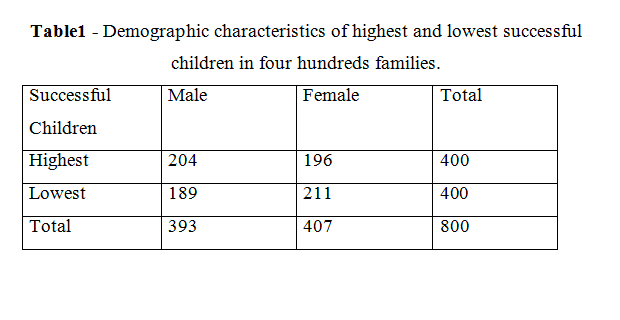
 References:
1-Wilson.E.O: Sociobiology: The New Synthesis, Cambridge, Harvard University Press, 2000.
2- Gardner. J. R: Sociobiology and Its Application to Psychiatry, Comprehensive Textbook of Psychiatry, 1995, 365-375.
|